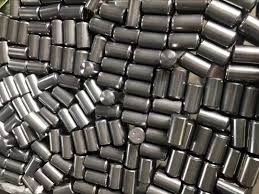
Purpose: To measure the density of tungsten and verify its purity level.
Method:
Density Testing: Uses techniques like the Archimedes method to determine the material’s density.
Purity Testing: Employs X-ray Fluorescence (XRF) or Inductively Coupled Plasma (ICP) analysis to detect impurities.
Importance: Ensures the material meets the required specifications for high-performance applications, such as aerospace components or radiation shielding.
High-Temperature Testing
Purpose: To evaluate tungsten’s performance under extreme heat conditions.
Method:
Thermogravimetric Analysis (TGA): Measures changes in weight at high temperatures.
Creep Testing: Assesses the material’s ability to withstand prolonged exposure to high temperatures without deforming.
Importance: Critical for applications like rocket nozzles, furnace components, and welding electrodes, where tungsten must maintain its integrity at high temperatures.
Hardness and Wear Resistance Testing
Purpose: To assess tungsten’s resistance to indentation, scratching, and wear.
Method:
Hardness Testing: Uses Rockwell or Vickers hardness tests to measure resistance to deformation.
Wear Testing: Evaluates performance under abrasive conditions using tribometers.
Importance: Ensures durability in cutting tools, machining equipment, and other wear-resistant applications.
Microstructural Analysis
Purpose: To examine the internal structure of tungsten at a microscopic level.
Method: Uses Scanning Electron Microscopy (SEM) or Optical Microscopy to analyze grain structure, identify defects, and detect impurities.
Importance: Helps in understanding the material’s properties and identifying potential weaknesses that could affect performance.
Mechanical Testing
Purpose: To evaluate the mechanical properties of tungsten, such as tensile strength, ductility, and fracture toughness.
Method:
Tensile Testing: Measures the material’s ability to withstand stretching or pulling forces.
Impact Testing: Assesses resistance to sudden impacts or shocks.
Importance: Ensures the material can endure mechanical stress in applications like heavy-duty machinery or aerospace components.
Corrosion Resistance Testing
Purpose: To evaluate tungsten’s resistance to corrosion in various environments.
Method:
Salt Spray Testing: Simulates harsh, corrosive environments to assess performance.
Immersion Testing: Measures resistance to chemical or water exposure.
Importance: Critical for applications in chemical processing or marine environments where corrosion can lead to failure.
Applications of Tungsten Testing
Aerospace: Ensuring performance in rocket nozzles, turbine blades, and other high-temperature components.
Industrial Tools: Verifying hardness and wear resistance in cutting tools, drills, and machining equipment.
Electronics: Testing for purity and conductivity in semiconductors and electrical contacts.
Medical Devices: Evaluating biocompatibility and durability in radiation shielding and surgical tools.
Defense: Ensuring reliability in armor-piercing ammunition and other military applications.
Why Choose Our Tungsten Testing Services?
Advanced Equipment: We use state-of-the-art instruments for precise and reliable testing.
Expertise: Our team of metallurgists and technicians has extensive experience in tungsten testing.
Compliance: Our testing ensures materials meet international standards like ASTM, ISO, and MIL-SPEC.
Custom Solutions: We tailor our testing protocols to meet your specific requirements.
Fast Turnaround: We deliver accurate results within agreed timelines.